Personal Finances and paying cash: you spend less

Updated: Jun 19
by Mag. Dobromir Risov, BSc. May 2026

Imagine paying cash for a new car
I remember a colleague, who was about 50 years telling me what his father had told him. His father had advised to pay for goods in cash. This former colleague of mine went on pointed at the BMW parked outside the building. He had paid in cash for it. Not by bank transfer, in cash. I was surprised to hear that. He also shared the reason for doing so: Again his father had said to him that it is important to develop a feeling what you are giving away and what you are receiving in return. These days many people pay cashless for small purchases. Can you. imagine paying in cash for a car? Can you imagine the amount? Say, the BMW cost € 50,000. The bank is probably provide the amount in € 500 banknotes. So, you would need to carry 100 banknotes with you: from the bank to the car dealer.
Starting small myself - pay cash for shoes
The story from my former colleague resurfaced my mind recently. Not long ago, I decided to purchase a new pair of shoes. I wanted to do so paying in cash. Before going to the store, I went to the ATM to withdraw the purchase amount, € 150. Holding the banknotes in my hand and realising I was about to give them away in some 30 minutes caused some pain in my belly. I think my colleague´s father was right: a feeling comes up when I realise I am giving something away to receive the shoes. And, for a moment I considered not buying the shoes. I asked myself: do I need them now.
Another surprise followed. In the shop the clerk was preparing card payment without asking. So, I said that I pay cash for the shoes. He was surprised. His head moved a bit backwards. So, I guess paying cash in that store is the exception not the rule. Today, in trade it is a lot about "a feeling", "an experience" "perception". When it comes to develop a feeling for the money you give away that feeling is not promoted when you pay cashless.
As I found out, people are aware that they are likely to spend more money when using a card instead of paying cash. This is revealed in a survey I found in a Forbes article. Yet the vast majority of people asked in the survey prefers paying by card. See further below.
Paying cash: the simplest expense tracker
Some people probably throw in paying by card or phone is handy. It is easy. O.K. True. But, is it unhandy when you pay in cash? Simply because one method of payment is handy, that does not mean another method is impractical. My own experience is this: When I introduced cash payment in my life, I was surprised how much money I was spending. How did I see that? I had no more banknotes in my wallet or pockets. That simple. I had to go frequently to the ATM. I started developing a feeling how much "life costs". That feeling that the father of the former colleague was talking about.
After a period of adjustment, I started to withdraw on a weekly basis. I knew better how much I had been spending. Withdrawing cash became a part of my routine. More positive effects from cash payment are: I know how much a taxi ride from the center to home costs. I know further that doing my groceries in one super market is better for my wallet than in another. How I know that? I leave one supermarket with goods and no banknotes in my wallet. In another supermarket I leave with goods and with some banknotes left in my wallet. No need to review the invoices. I already know where to shop and where not.
The other day at the supermarket I looked at my basket. I estimated the amount to pay at below € 20. I paid € 23. My estimate was off by 15%. That´s good. I remembered how in the past my estimate was off by a lot more. What had changed? I started paying cash.
When taxi drivers hear I pay cash they respond: "Cash is king." Maybe they are right.
Methods of payment in Europe
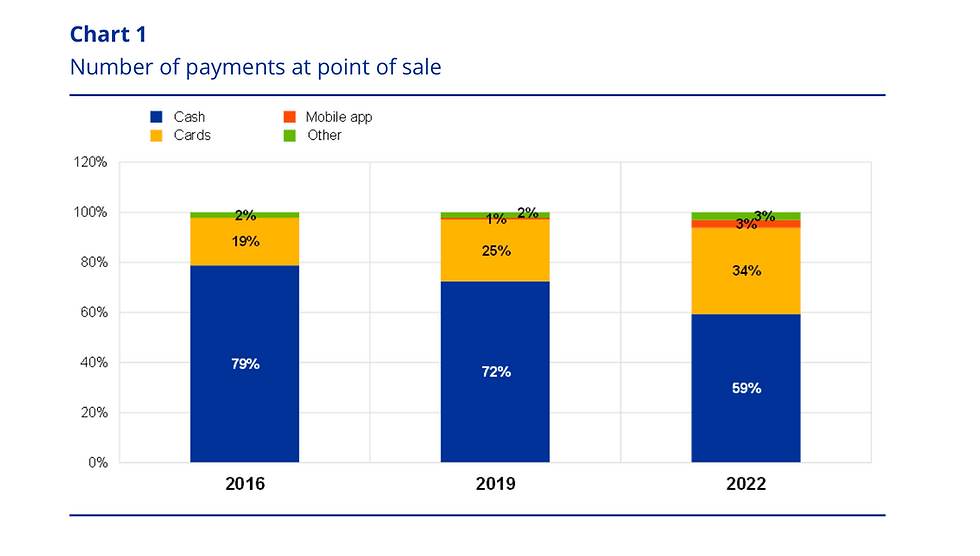
How do others pay? In a blog published by the European Central Bank I found this table regards methods of payment. The survey covers three different years across a period of six years. Results show customers in Europe say they pay mostly with cash - that is coins or banknotes. The share was at 79% in 2016, that share has dropped since then to 59%. A drop by 20%. During the same six year period card payments have gone up from 19% to 34%. An increase by 15%. Paying with a mobile app is a new method of payment. It did not exist in 2016, the first year of survey. In 2019 the share was 1%. That figure went up to 3% by 2022. Personally, the results strike me a contradiction with my own experience: the data indicates people in Europe pay more than 50% in cash; at the same time, the sales clerk at the shoe store was surprised mightily when I said I pay cash. Maybe the fact that the most recent data is 4 years old, explains the contradiction.
Methods of payment in the United States
I also found information on the United States. Following a Forbes article, people in the United States pay differently than in Europe. The data is from 2024, it is more up to date. The surveyed people mostly pay by card, 70% of the transactions. Paying cash comes second with 22%. 7% have responded to use digital wallets - for example Google Pay. In the United States a lot more transactions are paid with card than in Europe.
The world is much larger than Europe or the United States. What is the picture in other countries, say South Africa, India or China? Likely the results are going to differ. However what is going to be the same is the fact that paying by card increases the likely hood to spend more than when you pay cash. The idea here at Camel Personal Finance is for people to learn to spend their money better: for example stop buying some items, replacing other items or pay cash. Hence achieve more solid personal finances. What is the next step from here? No matter which country you are from, practice what you just read. Start paying cash. See how that works for you. Put knowledge into practice.
Frequently Asked Questions (FAQs)
How do I reduce my monthly expenses? You can start paying cash. Withdrawing a fixed amount at the start of the week and try to get through the week without deducting more. Occasionally resort paying by card. That is your first budget.
How do I increase my personal savings? Focus on reducing your expenses and not on increasing your income. With expenses there are often one or two items, you can immediately stop buying, replace or reduce. That adds up nicely over one year.
What is the biggest challenge to increase my personal savings? To start small and continue in that manner.
Is paying cash a blue print to become wealthy? No. It facilitates reducing your credit card debt or to increase your savings.
Sources
European Central Bank - cash or cashless? How people pay https://www.ecb.europa.eu/press/blog/date/2023/html/ecb.blog230206~1ea270a762.en.html
Forbes - People are twice (...)

Comments