Personal Investing is simple. Do you complicate it?

Updated: Jul 16
Mag. Dobromir Risov, BSc. April 2025

Intro
Today I want to talk about investing. It´s difficult to not have heard about it if you are watching the news, reading the newspapers or receiving an update on your employee benefit plan. You probably have bought some stock before or you own shares in a mutual fund. Have you pursued investing in a structured way on a continuous basis? Probably not. If personal investing feels like a maze to you then it´s likely as a result of a lack of structure in your investing endeavours. That´s what I am doing with this blog and with Camel Personal Finance: giving you structure. I talk today about the various categories as shown in the picture below. I then talk about stocks in more detail.
Main
Oxford Dictionaries defines “investment” as "investing money for profit." There are 9 investment categories on the picture below: stocks, mutual funds, bonds, land, real estate, artwork, cryptocurrency, gold and antique. It´s not an academic definition but it´s good enough for today.
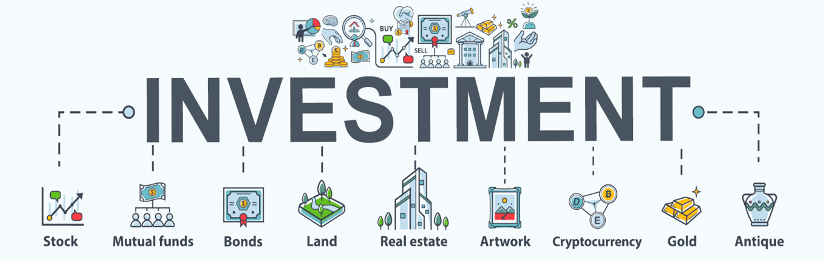
These categories have different characteristics. Some categories share common traits. For example stocks, mutual funds, bonds and real estate all generate revenue or income. There is a business connected with these investments. Land, artwork, crypto, gold and antique generate no income. That raises the question of being considered an investment.
Stocks represent ownership in a business. They pay dividends when the underlying business is profitable.. Bonds are one type of debt and generate interest income. Artwork produces no regular income. Unless a museum pays you a fee to show your artwork to the public. Now, from artwork to antique, as an owner you still can make a profit when you sell the item. It´s the same for watches and old timer cars. Both pay an emotional "income" as you enjoy wearing a beautiful watch or driving your special car.
Now, let´s go back to stocks. They generate exclusively a financial income. There are "stocks" and "stocks". I show four examples. Many stocks pay dividends. Some could pay dividends (profitable) but owners choose to retain earnings in the company entirely. For example Amazon stock. Amazon has not paid dividend once since its foundation. However owners of Amazon stock benefit through capital appreciation.
Apple started paying dividends again in 2012. Apple had stopped doing in so 1995. For 17 years no dividends were paid. The one source of profit for owners of Apple stock was through capital appreciation. Thirdly: Tesla. Tesla recorded a profit for a full year for first time in 2020. It´s stock however appreciated by a lot many years before the first profitable year. If you ask whether Tesla´s stock is valued fairly when the company had not yet recorded a profit some experts will say yes. Others will say no. You may have heard the saying: 2 doctors – 3 opinions?

It´s the same with stock market experts. Learn to develop your own opinion (Forecasting Markets & Stocks).
Then, there are stocks which appreciate modestly but produce steady dividends. Like Coca Cola for example. The company is part of the group of dividend aristocrats. One of the criteria is to pay and increase dividends annually for 25 years. There are many more stocks out there: per 2022, there are more than 58.000 publicly traded stocks worldwide according to the World Federation of Exchanges. Behind every stock there is a business. As stocks represent ownership in a business which can be sold and bought easily on a stock exchange.
Summary
News channels like to report on Amazon, Tesla or Apple. Yet, there are important differences between those tech stars. The highly concentrated reporting in the news does not reflect the stock market as a whole.
What applies to stocks also applies to mutual funds, bonds or real estate. There are important differences to consider and to be aware of. A private investor increases the chance of long term success by being aware of the differences: in terms of categories & in terms of variations within a category. I see personal investing having a resemblance with gardening: 1) it´s about having a plan, 2) laying the seeds, 3) showing patience, 4) maintenance and 5) enjoying the results. Probably personal investors complicate investing when they replace patience with over analysis and hyper activity. Moving beyong those 5 points or replacing them a personal investor complicates the process. When you want to start your own investment garden or change your current one go to: Courses (Item)
Sources:
Will Amazon ever pay a dividend? (Sure Dividend),
Apple Dividend Analysis: How It´s changed over the last 12 years (Investopedia),
How successful is Tesla? (Statista),
Dividend Aristocrats in Focus: Coca-Cola (Sure Dividend),


Comments