Sovereign Wealth Funds - Part 3

by Dobromir Risov March 2026

Introduction
I heard for the first time about Sovereign Wealth Funds during the Financial Crisis back in 2007. Other than that I haven´t heard from them again. They are rather quiet investors. And relevant. I wrote an introductory part (Sovereign Wealth Funds (pt.1). Today I want to go in more detail. I find it important albeit not crucial for a personal investor to familiarize himself with the landscape of investors.
Main
I remember the news on TV back in 2007: it was reported American Bank Citibank closes a deal for a capital increase. Citibank was under a lot of pressure. Following an article from Al Jazeera from November 2007, Citibank stock had dropped by 45% since the start of the year. Investors were selling the stock as a result of Citibank being hit by defaulting mortgage debt. Citibank wrote down its debt portfolio by around of 6,8 billion $ says the article. And, more write-offs could follow: up to 11 billion $ in the fourth quarter of 2007. The Sovereign Wealth Fund of Abu Dhabi, the ADIA agreed to invest fresh capital in Citibank. The Fund injected fresh capital of 6,8 billion $. The investment by the ADIA took place at a time when other investors such as retail investors were not willing to invest more. Also, the ADIA did not act as a charity. The Fund was well aware of the business risks. It asked for a high return: 11% as the article states.
After this capital increase the ADIA became one of the largest shareholders in Citibank. Another large shareholder was the PIF. That is another Sovereign Wealth Fund, from Saudi Arabia. Today, almost 20 years later, a review of Citibank´s shareholder structure reveals that the largest investors have changed: according to Motley Fool, the largest shareholders are Berkshire Hathaway, a financial company from the United States. And three very large asset managers mostly for retail investors: Vanguard, Blackrock and State Street, all three from the United States. The two Sovereign Wealth Funds, the ADIA and the PIF are not mentioned anymore.
Presenting three angles
Asset size of different investor types
You see three items in the chart below. Each represents a different investor type: the first item is the total asset size of the three largest Sovereign Wealth Funds. I used data from the Sovereign Wealth Fund institute website. The three Funds in question are the Norway Government Pension Fund Global (Sovereign Wealth Funds (pt. 2), the SAFE Investment Company Fund and the China Investment Corporation. The total asset size is 5,64 trillion $.

The second item are Hedge Funds. With a few exceptions Hedge Funds are reserved for very wealthy individual investors. According to Investopedia, the three largest Hedge Funds are Citadel, AQR Capital Management and Bridgewater Associates. Their total asset size is 0,75 trillion $. And the third item in the chart is a very large asset manager, called Vanguard. Vanguard focuses on retail investors. An opposite of Hedge Funds. Vanguard´s assets under management (as of April 2025) according to Statista are 10 trillion $. The data is from one year ago, I would say the most up to date figures do not change the picture.
Sovereign Wealth Funds come second in market value. The largest asset manager is not state run but it is a manager for retail investors, namely Vanguard. Hedge Funds, which may receive a lot of scrutiny in the media, manage the least assets, by far. Compared with Vanguard it is less than 10% of Vanguards assets under management. The three largest Sovereign Wealth Funds account for 50% of Vanguard. And: a quick look in the SWFI rankings shows: I need to add the assets of 8 Sovereign Wealth Funds to equal the market value of Vanguard.
Where are Sovereign Wealth Funds from?
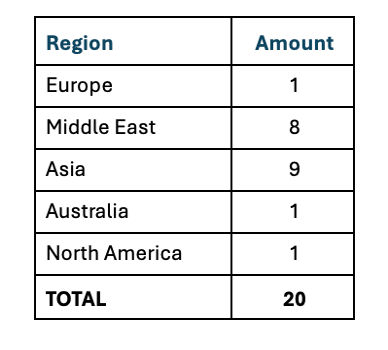
To answer that question I looked at the first 20 Sovereign Wealth Funds, using data from the SWFI website. As you see in the table to the left, many Funds are from the Middle East. The Middle East is a region rich in oil and gas. The majority are located in Asia, a total of 9. Funds from the Middle East and Asia total for 17 of the first 20 Funds. My sample is completed with Europe, Australia and North America each adding one Fund to total 20. It is not the United States but Alberta, a province in Canada which represents North America here. It is worth noting, geographically, the Middle East is much smaller than Asia, yet many Funds are from there.
What´s the asset distribution in geographical terms?
I picked for this chart the first 10 Funds using the SWFI ranking. Sovereign Wealth Funds from Asia make almost 6 trillion $ in assets. Funds from the Middle East have close to 4 trillion $ in assets. That is 2 trillion $ less than Sovereign Wealth Funds from Asia. At the same time the number of Funds from both regions are quite close.
Europe shows that the number of Funds is not a sufficient metric to assess: solely one Fund is from Europe, but that Fund alone is 2,12 trillion $ large. The asset size accounts for 50% of the total for the Middle East sample.

Summary
The personal investor is one of several types of investors. Knowing the other types is not key knowledge to succeed in investing. Yet it is good additional knowledge to have. I talked today about the Sovereign Wealth Fund. I presented in this part an in depth look at them. I analyzed the Sovereign Wealth Funds in three ways here: first comparing them with two other types of investors – Hedge Funds and a Retail Asset Manager. I showed with my analysis Sovereign Wealth Funds are not almighty. Then I showed where Sovereign Wealth Funds come from mostly: the Middle East and Asia. I finally looked at the asset size of the ten largest Sovereign Wealth Funds. What now for the reader of this blog? When you want to establish your own path to personal investing come visit the Course Site: Courses (List). The practical advice offered there comes from selected, excellent practice tested literature.
Frequently Asked Questions (FAQs)
1. Are Sovereign Wealth Funds important investors? Yes. When banks were in urgent need for fresh capital during the Great Financial Crisis, Sovereign Wealth Funds were one of the few investors willing to invest. They also asked a high profit in return.
2. How many Sovereign Wealth Funds are out there? The website SWFI lists 100 Sovereign Wealth Funds in its ranking. There are maybe more out there, but that´s a good number to work with.
3. What's the largest Sovereign Wealth Fund? The largest Sovereign Wealth Fund is from Europe. It is one of the few from that region. The Fund is called Norway Government Pension Fund Global. Read more in Sovereign Wealth Funds (pt. 2).
4. Where do mostly Sovereign Wealth Funds come from? From the largest 20 Sovereign Wealth Funds, 9 are from Asia and 8 from the Middle East.
5. Are Sovereign Wealth Funds too large? When compared with the largest Hedge Funds, Sovereign Wealth Funds are indeed much larger. When compared with one of the largest retail asset managers – Vanguard, Sovereign Wealth Funds are much smaller.
Sources
World´s Top Ten Hedge Funds - Investopedia
Who owns Citigroup? - Motley Fool
Abu Dhabi buys stake in Citigroup - Al Jazeera
Vanguard Assets Under Management - Statista


Comments