The Personal Investor: The components of business and speculation in the stock markets - a case study

Mag. Dobromir Risov, BSc, July 2026

Introduction
I present today two different stocks (shares). As you will read, this is what they have in common and differ in many areas. I had the idea for this blog, while I was working on the blog on Initial Public Offerings (IPO) and its relevance for a personal investor. Today, I present a case study on two companies. I write the case study focusing on their financials and price.
I will reveal the names of both companies at the end of the blog. I keep it this way to sharpen the view on the financial data for the reader. At the end I answer which stock I would buy. You can do the same for yourself and at the very end I disclose the names of the two companies.
Company 1
Company 1 was founded in 2002, almost to 25 years ago. According to Wikipedia Company 1 operates in the industries of space, telecommunications and artificial intelligence. Company 1 employs 22.000 people. I find in the Wikipedia article on one or two occasions that a quarterly profit has been recorded. Contrast several profitable quarters in the span of 25 years of operations of the company.
I present next the earnings for the last three years. This is a short term view. Company 1 recorded losses in two out of three years: 2023 and 2025. According to Barron´s Company 1 broke even in 2024. On the positive, the table below shows, Company 1 increased its revenue from 10 billion USD in 2023 to up to 19 billion USD in 2025. That is an increase of 80%. Yet the Company 1 remains loss making.

In spite of its lack of success, Company 1 went public in the first half of 2026. The company´s stock currently sells at around 160$. Company 1´s market capitalisation is more than 2 trillion USD. (Market capitalisation equals the stock price multiplied by the outstanding amount of stocks. Any outstanding debt is treated separately.) Surprisingly to me, in spite of Company 1 making losses for its owners, the stock (shares) is trading very high and so is its market capitalisation.
Company 2
According to Barron´s, Company 2 engages in the exploration, development and distribution of oil and gas. The company employs close to 60.000 people. Company 2 started 140 years ago as a regional marketer of kerosine. Since then Company 2 became one of the largest petrochemical enterprises worldwide according to its own website.
A quick look at its investor site reveals, Company 2 has been very successful for its investors. First, Company 2 paid dividends over the last 43 years without interruption. Second, Company 2 increased dividends at 6% annually over the same period.
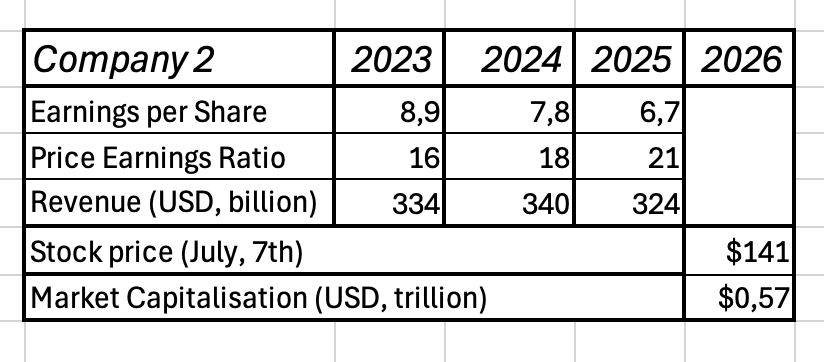
As to the short term financial view, Company 2 recorded profits for the last three years as you see in the table left. Company 2´s stock trades at 140 USD. Compnay 2 is profitable and so I can calculate the important Price Earnings Ratio. The Ratio ranges between 16 and 21 times: for the last three years. A level of 16 is attractive, 21 rather not. When you are unfamiliar with the Price Earnings Ratio, take the inverse of it. It gives you the earnings yield. During the preceding three years, Company 1´s revenue was stable at around 330 billion USD. The company´s market capitalisation is at 0.6 trillion USD per July 2026.
Analysis: the short and long term profit history for both companies
Let´s contrast the figures of the two companies with each other. You see the data in the third table below: Most striking to me is the total earnings for the last three years. Added together, Company 1´s earnings are at -0,7 USD loss. Company 2, offered its investors a total of 23,4 USD profits.
Second row, when I look at the total revenue, there is a huge discrepancy again: Company 2 recorded almost 1 trillion USD in revenue. That is more than 20 times Company 1´s revenue of 43 billion USD. Yet, Company 1´s stock trades 20 USD higher than the stock of Company 2.
Contradiction - profitable company for cheap, loss maker costs the stars
Company 2 spoils its investors from a business perspective as shown in table 3. And it is a bargain: it can be bought for 0,6 trillion USD. Company 2 costs less than a third of Company 1!

Personal investors buying stock of Company 2, can do so as a result of its financial/business data and price. It is profitable for its investors and is inexpensive too. What investors rely upon when buying shares in Company 1 I cannot say. It cannot be profitability. Maybe it is the hope for a grand future.
Conclusion
Personal investors often distract themselves from fundamentals and focus exclusively on stock price increases. In reference to the book The Intelligent Investor, price increases is the speculative element in investing. The personal investor however needs to also focus on the business component of every stock purchase. A speculation has little to no business component. But an investment also has some speculative element but it is dominated by business. A good lesson on what happens when there is solely a speculative element in a stock purchase, read the blog on the South Sea bubble South Sea Bubble - a lesson for personal investors. I would buy Company 2 stock (shares).
Which of the two companies would you buy?
Finally – the names of the two companies
As you have decided, I reveal next the names of both companies. Company 1 is Space X, a company from Elon Musk. Company 2, is the second largest oil and gas company, Exxon Mobil. Since we are coming to an end, when you are interested to learn more on investing intelligently, check out the course: Courses (List).
Frequently Asked Questions (FAQs)
1. What´s a good investment? That´s an investment with strong business and financial fundamentals. It contains a speculative element, yet that element is of minor role.
2. What´s a speculation look like? When there´s a massive lack of business rationale. So, there is purely relying on someone else paying you more for the asset than you paid yourself.
3. How do you characterise Space X from a personal investor´s point of view? The company is still in the start up stage, as it needs external funding to operate. The element of speculation is dominant. Even more so, when the start up stage lasts for more than 20 years.
4. How do you characterize Exxon Mobil from a personal investor´s point of view?
The company is profitable and stable. The company has paid dividends for 40+ years to its owners. It also succeeded increasing dividends too, every year. Business and finance fundamentals are strong.
Sources
Financial data - Barron´s - https://www.barrons.com
Space X information - Wikipedia - https://en.wikipedia.org/wiki/SpaceX
Chess picture - Word stock image

Comments