A Personal Investor and the allure of the wisdom statement: "stocks can only go up".

Mag. Dobromir Risov, BSc, October 2026

Introduction
Several statements regards investing and stock markets come to my mind. One example is "don´t catch a falling knife" or "stocks can only go up". Some statements support optimism, others prudence and pessimism. Today I want to put one of those statements to the test. The test being, comparing it to a real life example. That is, looking at the long term performance of one stock.
8,9% annualised compound return, I want that. Is there a catch? Yes.
A few facts about the company for today´s investment case study
I picked a company rich in history, its foundation going back to 1870, more than 150 years ago. The company operates in an established and essential business for the economy, that is banking. The bank in question is a prominent representative amongst its peers: it is amongst

the 25 largest banks worldwide from April 2026. In Europe it is amongst the Top 10 banks. The reader sees, I did the opposite of picking a company from a shaky business with doubtful future as its products are not needed. The bank in question is Deutsche Bank.The very long view – 10 years holding period I look at four periods in today´s case study. Starting with a period long enough to be considered as investing rather than entirely speculation - 3 years. Gradually I lengthen the investment period, stretching it up to 10 years in total. My starting point is in October 2016. Deutsche Bank shares traded then for 12€ as I show in the table above. When the Personal Investor looks at the table the 5 data points show some big downs and a one big up in the stock price movement, that is at the end of the observation period, in 2026. It is important to say that the Great Recession ended in 2009 and tidying up the aftermaths took additional years after that. My point being that the period of analysis, starting in late 2016, is after that negative economic event which depressed stock prices for years.
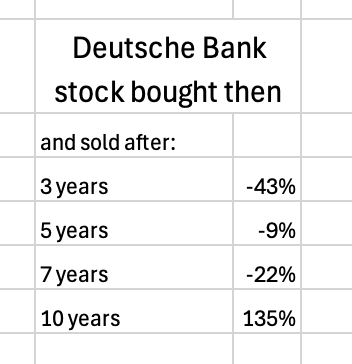
Based on the stock prices from table 1, I calculated the investment performance for each period in table 2. The performance of this investment after three years is horrible: assuming the investor had enough after three years, selling for 7€ leads to an investment loss of 40%+ pre tax. For a personal investor who kept his nerves and held the share for another 2 years, losses decreased during this period to 9%. If the personal investor had assumed, that it will get better – he was wrong (Personal Investing and the Belief of Forecasting Markets & Stocks). The equity price of Deutsche Bank dropped again, resulting in an investment loss of 22% after 7 years. Some of the personal investors would have said, “I wish I had sold after 5 years and bought Bitcoin” (A Review on Cryptocurrency as an Investment - part 2). Solely those few remaining investors who kept on to their stock after that 7 year threshold, received the rewards. The stock price went up to € 30 and thus increased by 135% compared with 2016. The statement “stock can only go up” holds true for this case study when looking at 10 years. On average the stock increased 13,5% annually. Readers beware: this average figure is deceptive, as those returns were not accrued evenly across 10 years. Rather disproportionately at the end of the period. Add to that the considerable temporary losses and investing turns for many into an emotional battle with themselves.
Some readers might throw in, hey did the company do poorly? Have a look: I show below, the earnings history of Deutsche Bank for the last 5 years. In short the bank was doing ok to good. The bank was profitable in every year. I further picked two years and calculated the Price Earnings Ratio based on my stock prices. For 2021, the P/E was at 12 times. That is the equivalent of 8,3% earnings yield for an investor. In 2023, the ratio was at 5 times! A P/E ratio of five times equals a 20% earnings yield. That is a ridiculously attractive valuation.

And yet, the stock was trading at 30% down from 2016.
A personal investor can hold a cheap stock of a profitable company and yet the profits will not show in the form of stock price increases. Logic occasionally shows up in stock markets.
Summary & Conclusion
Before a personal investor can enjoy a pre tax return of 8,9%, a personal investor would have to stomach the temporary market losses of up to 40%. That challenge becomes larger when you don´t know what the future holds: bear in mind, I write this case study looking backwards. It is much easier to do that, than holding on to the stock ex ante. My take is few personal investors would have held on to this investment, an investment which for the majority of the holding period was at a (huge) loss while being in a profitable position as a company. What a contradiction.

When a Personal Investor sees the stock exchanges as a casino and fast gains, 10 years become an unbearably long period. Those attractive 9% return don´t come evenly distributed every year smoothing the nerves of the personal investor, or the way you learned from finance academia, no, the return comes at the very last part of the 10 years. And then the return comes big and rewards the personal investor for the whole 10 years. It is decisive for personal investors to enter the markets with the right mindset to increase their chances of success. And, mindset is one decisive factor, knowledge another: I show to the personal investor here Courses (List) how to set up his own portfolio following knowledge from highly successful practitioners. With resources as small as 50 € monthly, a personal investor can start treating his savings the way they want to be treated.
Frequently Asked Questions (FAQs)
1. What is an important lesson about stocks and stock markets from this case study? An important lesson is, stocks or share prices, may not make sense for many, many years.
2. What does a Personal Investor do in such situations? A personal investor does well by accepting that unlogical behaviour. And rely and trust well prepared investment decisions.
3. What is the value of wisdom stock market statements for a personal investor? They are of little value and can be counterproductive. They do not replace knowledge and application.
Sources
Deutsche Bank equity data: https://live.deutsche-boerse.com/aktie/deutsche-bank-ag?mic=XETR
Earnings per Share data: https://www.faz.net/aktuell/finanzen/kurs/aktie/deutschebankagnaon/DE0005140008/tradegate/5864169/
Largest banks https://en.wikipedia.org/wiki/List_of_largest_banks
Deutsche Bank history details https://www.db.com/files/documents/Deutsche-Bank-History--Chronicle-from-1870-until-today.pdf
Great recession: https://en.wikipedia.org/wiki/Great_Recession

Comments