The Personal Investor and investment risk or driving forward while looking in the rear mirror. Part 2

Updated: 11 hours ago
by Mag. Dobromir Risov, BSc, September 2026

Risk changes when sampling changes
In Part 1 The Personal Investor and investment risk or do you know what you are doing? Part 1 I wrote about and calculated investment risk as presented in marketing materials or fact sheets of investment products. In Part 2 I will show the fluidity of the concept and its limitations of utility. Let´s get started by first writing about the Atlantic coast in Portugal.
More specifically, there is a famous small town called Nazare. To those interested in surfing, Nazare needs no introduction. To the others, well the shore in Nazare is one of the few spots on earth particularly suitable for big wave surfing. What that looks like, you can see for yourself on Youtube. During storm season – from November to March – assisted by a favourable ocean surface some of the biggest waves in the world are recorded there. The waves can reach up to 30 metres. In spite of the tremendous height, surfers surf them.
How dangerous is it to surf there? Here is the data: Last year, some 18 surfers participated in the big wave competition according to the worldsurfleague website. The competition consisted of 2 legs or heats per surfer. During those heats, they can surf several waves. Assuming an average number of 3 waves, a total of 108 competitive rides is the result. (Without considering practice rides.) Assuming further the same number for the last 15 years, I arrive at 1620 rides.
Next thing - injuries. When I looked up injuries in Nazaré, I came up in total of 5 injured and 1 mortality during a similar period. Leaving minor injuries aside which are not recorded, the injury risk is <1% given above data. Now, when I ask you: Hey, the risk to injure yourself during Nazare, is less than 1%. Are you going to take a ride? You would answer: No. Obviously not, because this risk figure is not representative for you. It is representative solely for professional surfers - within the sample of professional surfers again solely those specialised in big wave surfing. Your chances as an inexperienced surfer to injuring yourself are closer to 100%. This is a very good example for the importance of sampling when analysing risk. You have to know your sample to know what the probabilities are saying and more importantly what those probabilities are not saying. Going back to the topic at hand, investment risk, where does this leave us?
In part 1 I calculated investment risk for the DAX index for 2024. With the DAX the expected return and risk changes when you select a different year. This is true for other stock market indices too. The particular year is your sample. Every time you change the year of observation you change the sample and thus the results change. The differences in results can be small or large. For example, when I select the year 2007 or 2008, the differences are likely to be big.
Investment risk in DAX for 2008 vs 2024
In 2008 the economies and financial companies in particular were dealing with a crisis of the magnitude of the waves in Nazare during the storm season. For those not familiar can look up the details in Wikipedia https://en.wikipedia.org/wiki/Great_Recession.

To the left: I calculated for 2008 (the same indicators as for 2024): the risk is at 2,3%. That looks like little. But it´s not. When the personal investor compares it with the risk of 2024 the picture changes: in 2024, standard deviation was at 0,7%. In 2008 the daily risk was more than 3 times bigger. Also, the expected value in 2008 was negative, at -0,2%. This figure does not look like much either. And yet it is. When I compare it with 2024, the expected daily return was positive, at 0,1%. Think about it: a daily difference of 0,3% in your favour or not. compound that for a year. (I show the effect of small positive returns in part 1 - statistical performance.)
Now, when I look at the yearly return, the personal investor is starting to have a heavy belly ache. Maybe he wants to pour himself a whiskey: a DAX investment lost more than 40% during the 12 months of 2008. When a personal investor compares the highest and lowest daily returns in table 2, he sees: in 2008 the highest daily return was 5 times as large as that in 2024. And the lowest was 3 times as negative in 2008 compared with 2024. The personal investor sees the outliers in 2008 had a larger magnitude. Like the majority of daily returns observed in 2008, as shown by the standard deviation.
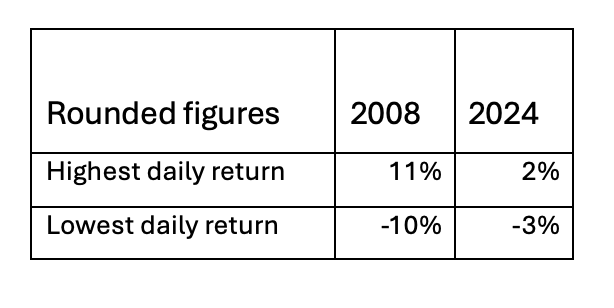
How many years does it take for your investments to make up for the 40% loss?
I read a non academical definition of what risk is: don´t lose money. Unfortunately that is not possible. Dealing with reality, I was curious to see how long it takes to make up for the 2008 losses. In the chart below you see the results for a 1.000 € investment in the DAX at the start of 2008. I show two investments - the blue line shows the investment based on the actual performance.

It takes until the end of 2013, that is 5 years, to make up the losses. Yes, the investment is close to breaking even after 4 years. You understand now why there is the saying: don´t lose money. Taking the whole investment period in consideration (including 2008), the investment average return is 3+% per year. The performance is meagre. However, considering your sample – it is actually alright. Of course provided the personal investor had the nerves to hold on to the investment.
I added a second calculation, shown by the orange line. You notice the line is straight after 2008 every year. The equal straightness indicates it´s slope is the same across every year. That also means, the return is the same for every year: I used the 2024 DAX performance of 18%. We see fiction is better than reality: the investment breaks even faster. By the end of 2011, 3 years after 2008, the invested amount reaches 976€, 2% shy of breaking even. Also, the investment reaches an average profitability of 3%, one year earlier than the “reality”. Finally bare in mind it takes a long three years to break even, even when the yearly return is as high, as 18%.
Conclusion
Moving to the fourth quarter of 2026 a personal investor asks himself: considering the data presented, what data do I use to manage investment risk for 2027? The data from 2008, or the data from 2024 or that of 2026? My answer is, I don´t know. I would also not believe anyone who says, he knows. There is one important take away from all those calculations and analysis: when you use or read this type of data, take it with a smile. Do not take it too seriously when making your investment decision. You realise why: based on sampling selection the return and risk figures change. And how do you know which sample year to select?
Often personal investors are thirsty for performance and fall for the illusion of forecasting the future Forecasting Markets & Stocks. Then they are susceptible to taking poor investment decisions. That in turn often leads to losing money unnecessarily. While losing money is part of investing, losing it unnecessarily is another thing. Here comes the hint to book the course Courses (List), There you learn to invest following very successful practitioners.
Frequently Asked Questions (FAQs)
What is the disadvantage of the expected return - standard deviation investment risk model? The results are fluid. They change when the sample period changes.
What is the lesson for personal investors following that insight? They need not rely much on this data when taking investment decisions unless they expect next year to be the same as last year.
What can personal investors learn from past crisis years like 2008? For once personal investors need to show strong nerves. Second, they need to show patience, as breaking even with pre crisis levels took five years.
Is there a recommendation for personal investors? To accept the future is not foreseeable. Relying on forecasts, your own or someone else´s often comes expensive in emotional and financial terms.
Sources
Big Wave Surfing competition - https://www.worldsurfleague.com/events/2025/bwt/472/tudor-nazar-big-wave-challenge/results


Comments